
If you have only ever dealt with regular health insurance, the workers’ compensation system will feel backwards. Under a health plan, the default is that nothing is covered until somebody approves it. In New York workers’ compensation, the default is the opposite: most of the treatment you need is already authorized by rule, and the insurance carrier has no say in it at all.
That rule is the Medical Treatment Guidelines. Understanding what they cover, and the narrow set of situations where your doctor does have to ask permission first, is the difference between waiting three weeks for a phone call that was never required and getting the care you need.
What the Medical Treatment Guidelines are
The Board adopted the first four Guidelines in December 2010, covering the neck, back, shoulder and knee. There are now sixteen, and the current editions apply to dates of treatment on or after May 2, 2022:
- Mid and Low Back Injury
- Neck Injury
- Shoulder Injury
- Knee Injury
- Hip and Groin Disorders
- Ankle and Foot Disorders
- Elbow Injuries
- Hand, Wrist and Forearm Injuries, including Carpal Tunnel Syndrome
- Non-Acute Pain
- Complex Regional Pain Syndrome
- Traumatic Brain Injury
- Eye Disorders
- Post-Traumatic Stress Disorder and Acute Stress Disorder
- Work-Related Depression and Depressive Disorders
- Occupational/Work-Related Asthma
- Occupational Interstitial Lung Disease
They are incorporated by reference into the Board’s regulations at 12 NYCRR § 324.2, which is what makes them law rather than advice. The Board’s own language is that use of the Guidelines “is mandatory for treatment rendered for conditions for which there is a final effective MTG.”
Mandatory for whom matters as much as mandatory for what. The Guidelines bind every payer in the system: private carriers, the State Insurance Fund, private and municipal self-insured employers, group self-insured trusts and all of the Special Funds. They also apply to claims under the Volunteer Firefighters’ Benefit Law and the Volunteer Ambulance Workers’ Benefit Law. There is no carrier in New York that gets to operate outside them.
The default: nobody has to ask
Here is the sentence that resolves most arguments before they start. If your treatment is for an established body part and condition and it is consistent with the applicable Guideline, prior authorization is not required. Your doctor does not submit a request. The carrier does not approve it. There is nothing for anyone to sit on.
So when an adjuster tells you your physical therapy “hasn’t been approved yet,” the first question is not when approval is coming. It is whether approval was ever required.
That is the rule. In practice, expect your doctor to file an MTG Confirmation PAR anyway, for physical therapy and for most other treatment. It is optional and a great many providers submit one every time. The reason is Form C-8.1B: if the carrier later objects to the bill on the ground that the treatment was not a correct application of the Guidelines, the provider is the one left holding it, because a provider cannot bill you for treatment of a work injury. A confirmation before the fact moves that risk. Hospitals and surgical centers have their own version of the same instinct and generally want approval paper in hand before they will put you on a schedule.
Knowing that changes what you should be watching. A confirmation request your doctor did not have to file still puts the carrier on a clock — eight business days — and on that request the carrier cannot send you for its own examination first, and cannot have a claims adjuster deny it, because a denial has to be reviewed by a physician. So if your physical therapy has been “pending approval” for three weeks, something has gone wrong that is worth a phone call, whether or not the request was ever required in the first place.
What the carrier keeps is the right to object to the bill afterward, on Form C-8.1B, by claiming the treatment was not a correct application of the Guidelines. That objection gets decided by the Board, not by the carrier. It does not become your problem: a provider who treats a work injury cannot bill you and cannot bill your health plan.
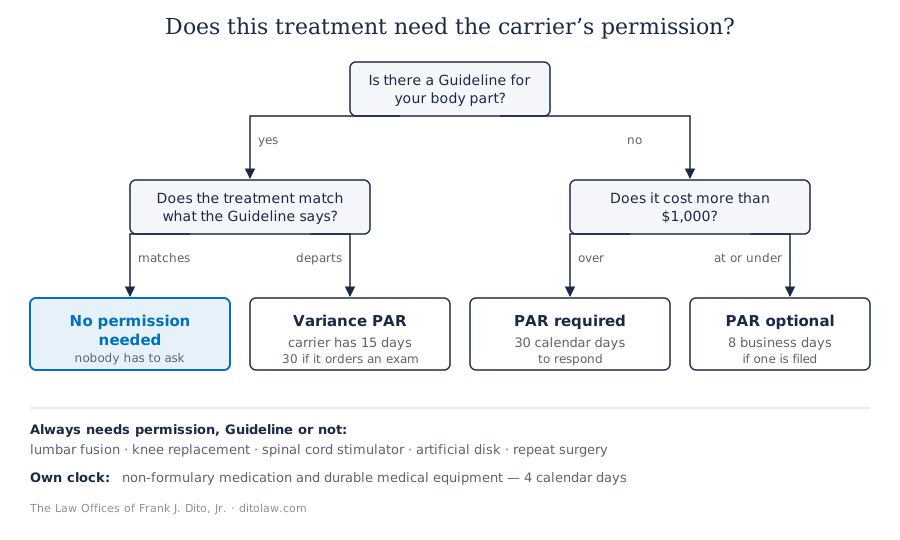
When your doctor does have to ask: the seven PARs
Requests for authorization are now made electronically through the Board’s OnBoard system, and they are called Prior Authorization Requests, or PARs. The paper forms people still find online — MG-1, MG-2 and C-4AUTH — were retired and can no longer be used to request treatment. There are seven PAR types:
- MTG Confirmation. Optional on paper, routine in practice. It asks the carrier to confirm that a proposed treatment is a correct application of the Guidelines, and it is the request most often sitting behind a delay in treatment that did not legally require permission at all.
- MTG Variance. For treatment that departs from the Guidelines.
- MTG Special Services. For the specific procedures that always require permission, listed below.
- Non-MTG Over $1,000. For a body part or condition with no Guideline, where the treatment or testing costs more than $1,000.
- Non-MTG $1,000 or Less. Same situation, smaller number. This one is optional.
- Medication. For drugs not on the New York Workers’ Compensation Drug Formulary, including medical marijuana.
- Durable Medical Equipment. For equipment not on the DME fee schedule, or on it but flagged as requiring authorization.
Your doctor does not have to know which one to file. OnBoard asks a series of questions about the proposed treatment and picks the PAR type from the answers.
The procedures that always require a PAR
Some treatment sits inside the Guidelines and still requires permission every time, because it is major and expensive. The Board’s list, at 12 NYCRR § 324.3(1)(a), is:
- Lumbar fusion
- Artificial disk replacement
- Vertebroplasty and kyphoplasty
- Electrical bone growth stimulators
- Spinal cord stimulators
- Peripheral nerve stimulation
- Osteochondral autograft
- Autologous chondrocyte implantation
- Meniscal allograft transplantation
- Knee arthroplasty, total or partial
- Sacroiliac joint fusion
- Repeating a surgery that failed or only partly worked, where the Guidelines do not address multiple procedures
Note the last one. A second or subsequent surgery needs authorization for any body part covered by a Guideline, and any surgery costing more than $1,000 needs it even where no Guideline applies.
Injuries with no Guideline
There is no Guideline for a great many injuries — a wrist fracture is covered, a broken jaw is not. For those, the rule is a dollar threshold. Treatment or testing costing more than $1,000 requires a PAR. At $1,000 or less, the PAR is optional, though filing one puts the carrier on a clock and gets you an answer on paper. Both deadlines are in the table below.
The variance, and what your doctor has to prove
A variance is the request that matters most in a contested case, because it is where the Guidelines stop describing your particular body. There are three kinds: treatment that goes beyond the maximum duration or frequency the Guideline recommends, treatment the Guideline recommends against, and treatment the Guideline does not address at all.
The burden of proof is on the provider, and it is specific. Every variance request must include:
- A medical opinion explaining why the proposed care is appropriate and medically necessary for you
- Certification that you agree to the proposed care
- An explanation of why the alternatives under the Guidelines are not appropriate or not sufficient
To extend treatment past the recommended duration, the doctor must add objective evidence that the treatment has produced functional improvement, a statement that further improvement is reasonably expected, and a plan with duration, frequency and functional goals. For treatment the Guidelines do not recommend or do not address, the doctor must document the signs and symptoms that failed to improve under Guideline care, a treatment plan with functional goals, and medical evidence supporting the proposed treatment — which can include peer-reviewed literature.
Two hard rules sit on top of all that. The variance must be requested before the care is provided. The regulation says a request “will not be considered if the medical care has already been provided.” And if the variance is denied and not overturned, the treatment is not authorized and is not supposed to happen at all — you cannot pay for it yourself, your health plan cannot pay for it, and your doctor cannot provide it for free.
The clocks
A carrier does not get to sit on a request. Every PAR type carries its own deadline, and they are not the same deadline — which is the detail that gets missed most often. This is the table worth keeping:
| Request | Carrier must respond within |
|---|---|
| Medication, non-formulary | 4 calendar days |
| Durable medical equipment | 4 calendar days |
| MTG Confirmation | 8 business days |
| Non-MTG treatment, $1,000 or less | 8 business days |
| MTG Variance or MTG Special Services | 15 calendar days |
| MTG Variance or Special Services where the carrier wants an exam or record review first | 30 calendar days, but only if it gives notice within 5 business days |
| Non-MTG treatment over $1,000 | 30 calendar days |
The extension on the bottom half of that table is worth understanding, because carriers treat thirty days as the ordinary deadline on a variance and it is not. The ordinary deadline is fifteen. Thirty is available only if the carrier notifies the Chair and the requesting provider through OnBoard, within five business days of the request, that it wants an independent medical examination or a records review. Miss that five-day window and the carrier is still on fifteen days. You and your attorney receive that notice too, which means the date it arrives tells you exactly which clock you are on.
This is where an ordinary scheduling problem turns into a denial. If you miss that independent medical examination, or reschedule it outside the carrier’s window, OnBoard gives the carrier a denial category for exactly that — and your treatment request dies on a calendar technicality rather than on the medicine. A denial on that ground can be brought to the Board on a Request for Further Action, but the simpler answer is to treat the IME appointment as immovable and call your attorney the day the notice arrives.
What happens when a carrier blows one of these deadlines, and how a denial moves through Level 1, Level 2 and Medical Director’s Office review, are covered on our page on what to do when the carrier denies your medical treatment. On a medication request, missing the deadline is fatal to the carrier’s position.
Things about this system that surprise people
- Your doctor cannot bill you, and you cannot volunteer to pay. The Workers’ Compensation Law prohibits a provider from charging you directly or billing another health plan for treatment of a work injury.
- The carrier can pick where you get your MRI. The Guidelines do not touch a carrier’s right to direct you to its diagnostic network, so long as it notifies you properly under WCL § 13-a(7).
- Maintenance care is capped. Once you have reached maximum medical improvement with a permanent disability and chronic pain, and a decline in function without treatment is documented, you can have an ongoing maintenance program of up to 10 visits per year — per body part. No variance for more is allowed.
- A flare-up does not need a variance if the initial treatment for it fits the Guideline. Treatment that is different, longer or more frequent does.
- Guideline durations run in consecutive weeks. Eight recommended weeks means eight weeks on the calendar, not eight weeks of appointments you attended.
- Changing doctors does not reset the count. Your new provider picks up where the last one left off.
- Home physical therapy counts toward the total the Guideline recommends.
- Out-of-state treatment is still governed by all of this. A provider in New Jersey or Florida treating a New York claim follows the Guidelines and the PAR process.
- A settlement can end the whole structure. If a Section 32 agreement waives your right to future medical benefits, the Board loses jurisdiction and you pay for your own care from then on. The Guidelines may still be the standard of care, but they stop protecting you.
One thing this system does not decide is who is allowed to treat you in the first place. That is a separate requirement, and it is being removed on January 1, 2028 — see can I use my own doctor for workers’ comp in New York.
Frequently asked questions
My doctor says I need more physical therapy and the carrier says no. Who wins?
It depends entirely on whether the additional therapy is within the Guideline or beyond it. Within it, the carrier has no role and no ability to stop it. Beyond it, your doctor needs a variance and has to document objective functional improvement from the therapy you have already had. That documentation is usually what the case turns on.
Can I just pay out of pocket for treatment the carrier refused?
No. New York does not permit it for a work injury. If a variance is denied and not overturned, the treatment is not authorized, and a provider is not allowed to bill you, bill your health insurance, or provide it free of charge. That is why fighting the denial is the only path.
Why did the carrier send me to its own doctor over a physical therapy request?
Because on a variance it is allowed to, if it says so within five business days of the request. That notice is also what moves its deadline from fifteen calendar days to thirty. Keep the appointment — missing it hands the carrier a denial reason that has nothing to do with whether you need the treatment.
My injury is not on the list of sixteen. Does that mean nothing is covered?
No, it means a different rule applies. With no Guideline for your body part, treatment over $1,000 needs a PAR and the carrier gets 30 calendar days. Below that figure the request is optional and the carrier gets eight business days.
My doctor filed a form called an MG-2. Is that still valid?
No. The MG-1, MG-2 and C-4AUTH forms were replaced by PARs in OnBoard and can no longer be used to request treatment or testing. A lot of advice online has not caught up, and a request on the wrong paper is a request that does not exist.
Can my lawyer file the request for me?
No. Only your treating provider can submit a PAR, and physical therapists and occupational therapists cannot submit one at all — the referring physician, nurse practitioner or physician assistant has to. What your attorney can do is make sure the request is documented the way the regulation requires before it goes in, and take a denial to the Board.
If your treatment is stuck
Most of the time the fix is not an appeal. It is finding out which of these rules actually applies to what your doctor ordered, and then holding the right party to the right deadline. Call 718.701.2776 or 800.310.5520 for a free consultation.
This page describes New York law in general terms. It is not legal advice about your claim, and reading it does not make us your attorneys.
