
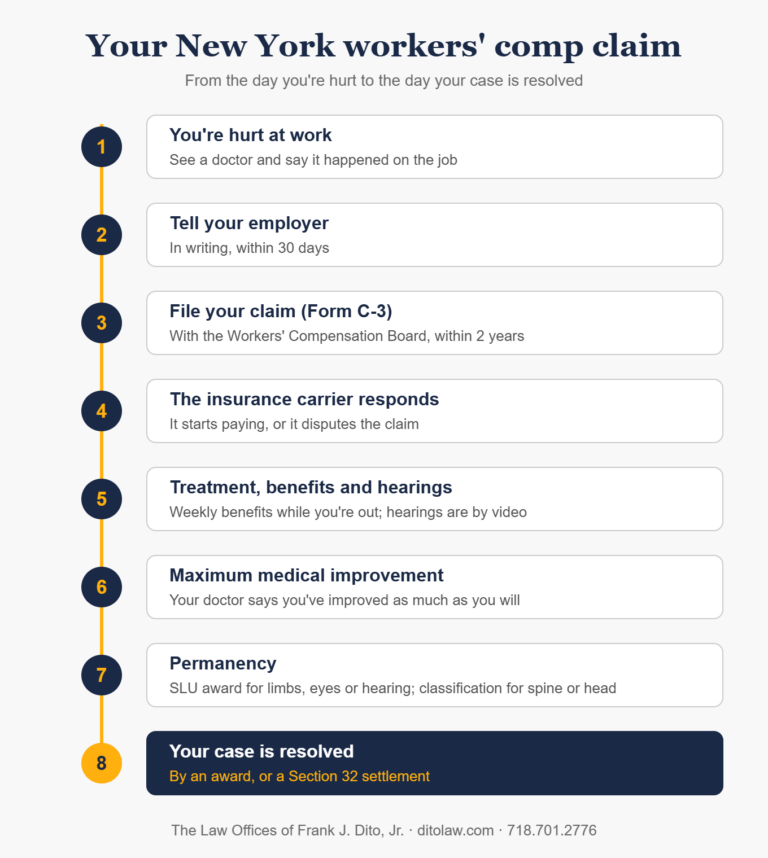
After a work injury, the first question most people ask is not about the law. It is when the money starts. In New York, the answer depends mostly on one thing: whether the insurance carrier accepts the claim or fights it. The law gives carriers short deadlines either way.
The short answer
- If the carrier accepts the claim: the first payment is due on the 14th day of disability and must go out within 18 days after the disability began, or 10 days after your employer learned of the accident, whichever is later.
- If the carrier contests the claim: it has to say so within the same 18-day window, and no later than 25 days after the Board mails its notice of indexing. A judge then decides the claim, which usually takes months. Benefits are paid back to the start of your lost time if you win.
- The first week is unpaid unless you are out more than 14 days, in which case it is paid too.
- Medical care is covered from day one on an accepted claim.
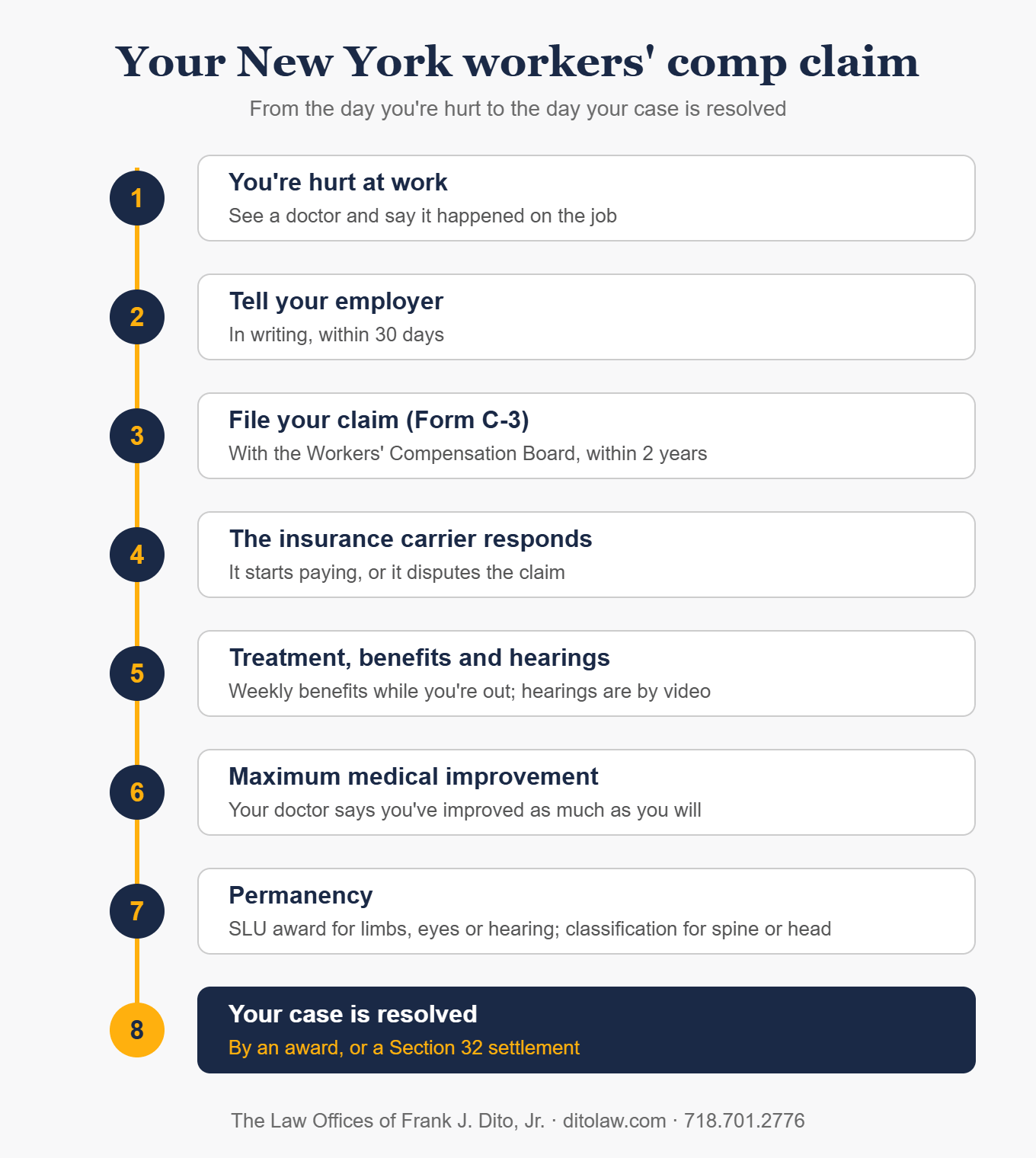
Step by step: from the injury to the first check
1. You report the injury
Tell your employer in writing within 30 days. A text or email to your supervisor that says what happened and when is enough, and you should keep a copy. Late notice is one of the defenses carriers raise; see our post on accident, notice and causal relationship.
2. Your employer reports it to the carrier
Employers must report a work injury within 10 days when it causes lost time beyond the day of the injury or medical care beyond basic first aid. If your employer drags its feet, the clock that matters to you still runs from when it learned of the accident.
3. You see a doctor and file your claim
Treat with a doctor authorized by the Workers’ Compensation Board and tell the doctor the injury happened at work. The doctor’s report is what tells the carrier and the Board that you cannot work, and with what percentage of disability. Without it, there is nothing to pay on. Our guide to finding a workers’ comp doctor explains how. File your own claim, Form C-3, with the Board. The legal deadline is two years, but filing in the first few days is what gets the claim moving.
4. The Board indexes the claim
When the Board receives the employer’s report, your claim form or a medical report, it opens a case, assigns a WCB case number and mails a notice of indexing to everyone involved. That notice starts the 25-day clock for the carrier to contest.
5. The carrier pays or contests
The carrier has to do one or the other within 18 days after your disability began, or 10 days after the employer learned of the accident, whichever is later. If it pays, checks usually come every two weeks after that. If it contests, it files a notice of controversy and the claim goes to a hearing.
The seven-day waiting period
New York does not pay cash benefits for the first seven days of disability. If you are out of work for more than 14 days, the carrier owes you for those first seven days as well. So a short absence of a week or less produces no check at all, while a longer one is paid from the first day. Medical bills are covered from the first day either way.
How much the first check will be
An accepted claim is paid at two-thirds of your average weekly wage, multiplied by your degree of disability and capped at the state maximum. Our benefits calculator gives a rough figure. Before any hearing, the carrier often pays on its own, sometimes at the full rate. That can change after an independent medical exam, and the carrier can cut the rate without a hearing; see why the carrier reduced your checks after an IME.
If the carrier contests the claim
A notice of controversy means no checks until a judge decides the claim. The Board schedules a pre-hearing conference, then testimony and medical evidence, and a contested claim usually takes months. If the claim is established, the judge awards benefits back to the start of your lost time. Our page on denied workers’ comp claims covers the process.
In the meantime:
- Keep treating, using private health insurance if you have it. See how to pay the bills while your claim is controverted.
- Apply for New York disability benefits through your employer’s plan if you are out of work. They can be paid while the comp claim is contested, and they are repaid out of the comp award later.
- Keep every medical report, pay stub and letter.
- If a doctor or hospital bills you, do not pay it; see medical bills and collection letters on a comp claim.
If the carrier misses its deadlines
The deadlines have teeth. If the carrier does not contest within 25 days of the notice of indexing, it is generally barred from arguing that you were not an employee or that the injury did not happen at work, unless the Board allows a late filing for good cause. Installments not paid within 25 days after they are due carry a 20 percent penalty, and so do award payments not made within 10 days, unless the Board excuses the delay. The Board can also assess a $300 penalty, payable to you, when the carrier neither pays nor contests on time.
None of that happens automatically. Someone has to raise it with the Board. Our post on carrier penalties for delay explains how.
Why your check may be late
- No claim in the system. The employer never reported it and you have not filed a C-3.
- No medical report saying you cannot work. This is the most common reason. Ask your doctor to give a percentage of disability at every visit and make sure the report is filed with the Board.
- The carrier is waiting for wage information. Payroll records from your employer, or from a second job, set your rate.
- The claim is contested. A notice of controversy stops voluntary payment until a hearing.
Once the checks start, the next question is how long they will keep coming. See how long workers’ comp lasts in New York.
Frequently asked questions
How long does it take workers’ comp to start paying in New York?
If the carrier accepts the claim, the first payment is due on the 14th day of disability and must be paid within 18 days after the disability began or 10 days after the employer learned of the accident, whichever is later.
How long does the insurance carrier have to approve or deny my claim?
The carrier must start paying or file a notice of controversy within 18 days after the disability began or 10 days after the employer learned of the accident, whichever is later. Once the Board indexes the claim, the carrier has 25 days from the mailing of the notice of indexing to contest it; after that, it generally cannot argue that you were not an employee or that the injury did not happen at work, unless the Board allows a late filing for good cause.
Is there a waiting period for workers’ comp in New York?
Yes. No cash benefits are paid for the first seven days of disability. If you are out of work for more than 14 days, you are paid for those first seven days too. Medical care is covered from the first day.
Why haven’t I received a check yet?
The most common reasons are that the claim has not been reported or filed, there is no medical report in the Board file saying you cannot work, the carrier is waiting for wage information, or the carrier has contested the claim. Each one has a different fix.
What happens if the carrier pays late?
The law adds a 20 percent penalty to installments not paid within 25 days after they are due, and to award payments not made within 10 days, unless the Board excuses the delay. The Board can also assess a $300 penalty, payable to you, when a carrier neither pays nor contests on time.
How long does it take if my claim is contested?
A contested claim has to be decided by a judge, and that usually takes months, not weeks. Benefits are generally not paid in the meantime, but if the claim is established, they are awarded back to the start of your lost time.
Talk to a New York workers’ compensation attorney
The Law Offices of Frank J. Dito, Jr. handles workers’ compensation claims from the office on Staten Island, for injured workers throughout the five boroughs and across New York State.
Call 718.701.2776 or 800.310.5520. Consultations are free. If we don’t recover money for you, we don’t get paid.
